Treon IQ: The New Industrial AI That Automates Operational Understanding and Recommends Actions
DALLAS, Sept. 15, 2026 /PRNewswire/ -- Treon Inc. today announced Treon IQ, a next-generation industrial AI capability that brings situational understanding to the company's market-leading Treon Connect Prescriptive Maintenance cloud platform. Instead of spending valuable time investigating dashboards, correlating data, and determining next steps, maintenance organizations can rely on Treon IQ to continuously analyze operational conditions, diagnose issues, identify optimization opportunities, and recommend actions. By transforming asset intelligence into continuous operational understanding and guided execution, Treon IQ helps teams resolve issues faster, improve consistency, and operate with expert-level insight across sites, fleets, and facilities.
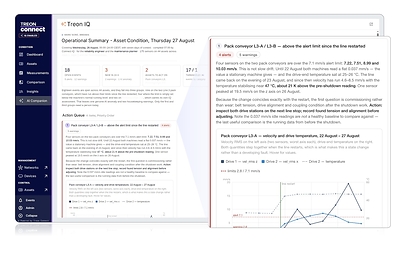
Bringing Industrial Understanding to the Next Level
Industrial maintenance workflows remain heavily dependent on human-led analysis and decision-making. While asset monitoring and fault detection have become largely automated, understanding what is happening and what should be done next still relies on human expertise. The result is often slow, costly, inconsistent, and difficult to scale.
Building AI systems capable of performing these tasks autonomously is equally challenging. Developing in-house diagnostic and recommendation models requires vast amounts of data, training, and computing resources. Horizontal AI layers depend on third-party sensor data, limiting their reasoning capabilities, while general-purpose large language models (LLMs) often lack the industrial context required for reliable operational decisions.
Introducing Treon IQ
Treon IQ extends the Treon Connect platform with an AI engine that automatically transforms asset data into continuous situational understanding.
The solution analyzes data from real-time and historical asset intelligence and other sources such as CMMS and ERP systems. It detects and diagnoses issues, uncovers optimization opportunities, explains root causes, and generates actionable recommendations for fast and consistent resolution.
Treon IQ combines the company's proprietary anomaly detection technology, next-generation deep-learning diagnostic models, and carefully selected LLMs into a unified framework. High-precision wireless sensors within the vertically integrated Treon Connect platform provide deep visibility into asset behavior, creating a stronger foundation for accurate diagnostics and recommendations than horizontal AI approaches that lack in-depth asset intelligence.
Instead of relying on alerts, vibration data, and condition-monitoring dashboards, Treon IQ introduces an AI-powered companion that provides maintenance managers with a continuously updated operational briefing summarizing site status, active issues, optimization opportunities, and prioritized actions, eliminating the need to spend valuable time investigating data and dashboards.
From Asset Intelligence to Operational Understanding
As a result, Treon IQ delivers accurate, reliable, and scalable operational understanding while maintaining optimized computing resources and predictable costs. By automating analysis, diagnosis, and recommendations, companies can improve consistency, accelerate resolution, and provide maintenance teams with expert-level guidance every day.
"Industrial AI should do more than detect anomalies. It should help maintenance teams understand what's happening and confidently decide what to do next," said Joni Korppi, CEO of Treon. "With Treon IQ, maintenance managers no longer need to start their day chasing alerts and investigating dashboards. Instead, they can begin each day with a complete understanding of their operational situation, key priorities, and the plan for the day, delivered automatically through an AI-powered companion in Treon Connect."
Availability of Treon IQ
An early-access version of Treon IQ is now available for Treon Make and Treon Flow customers, including tailored AI-powered companion functionalities for maintenance managers. Additional features will be introduced as new capabilities become available.
Treon IQ Demonstrated at IMTS 2026
Treon is introducing and demonstrating Treon IQ for the first time at IMTS 2026, taking place September 14-19, 2026, at McCormick Place in Chicago, showcasing how an AI-powered companion transforms a maintenance manager's work from investigating dashboards to understanding operational situations and confidently deciding what to do next.
About Treon
Treon is a global leader in AI-driven Smart Industry solutions, helping businesses improve productivity, operational visibility, and long-term sustainability. Its fully integrated predictive maintenance solutions combine advanced AI analytics, a mobile-first user experience, automated workflows, and wireless vibration monitoring delivered as a managed service with scalable subscription pricing. Treon operates in Finland, France, and United States, serving more than 200 customers worldwide across manufacturing, material handling, and logistics hubs. Learn more at Treon.
 View original content to download multimedia:https://www.prnewswire.co.uk/news-releases/treon-iq-the-new-industrial-ai-that-automates-operational-understanding-and-recommends-actions-302878972.html