Sungrow and be.storaged strengthen partnership for gigawatt-hour-scale battery storage projects
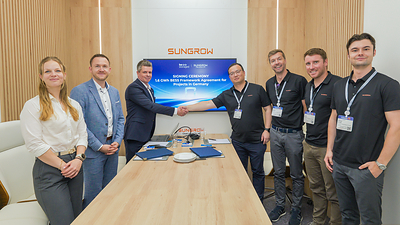
MUNICH and OLDENBURG, Germany, Sept. 18, 2026 /PRNewswire/ -- Sungrow Deutschland GmbH and be.storaged GmbH have signed a framework agreement for continued cooperation on large-scale battery energy storage (BESS) projects. The agreement strengthens the companies' long-standing partnership and lays the foundation for even closer cooperation in the planning, development, and implementation of BESS in Germany. Over the next two years, the partners aim to jointly deliver battery storage projects with a planned pipeline of 1.6 GWh of storage capacity.
Extension of Partnership
The energy transition requires high-performance storage solutions to make renewable energy available whenever it is needed. Against this backdrop, be.storaged and Sungrow have placed their existing cooperation on a new footing by defining the key principles of their future partnership in a framework agreement. The agreement aims to further intensify cooperation across the entire project development process, making battery storage projects more efficient to deliver. Standardized processes, coordinated technical solutions, and early joint planning are intended to accelerate project execution and reduce coordination requirements and feedback loops.
"With this framework agreement, we are creating far more than the basis for implementing individual storage projects," said Dr Magnus Pielke, Managing Director of be.storaged. "Together with Sungrow, we are establishing a long-term partnership that will enable us to standardise BESS projects at gigawatt-hour scale and bring them to market even faster in the future. Close cooperation will allow both companies to respond earlier to market changes and regulatory requirements. At the same time, we are creating structured feedback loops between project development, plant operation, and technology development. Insights from planning, construction, and operation can therefore feed directly into the ongoing development of future storage solutions. This is an essential prerequisite for industrialising the operation of growing storage fleets and unlocking synergies in plant management. It will also enable us to develop additional business potential together across the battery storage value chain and expand the business into adjacent areas."
Moritz Rolf, Vice President and Regional Manager DACH, Benelux, Nordics and Turkey at Sungrow Europe, said: "Our long-standing cooperation with be.storaged is founded on trust, technical expertise, and a shared understanding of the technical requirements of the German energy storage market. With the framework agreement, we are establishing the basis for even closer collaboration on future projects, efficiently bringing innovative storage technologies to market, and strengthening the energy transition in Germany."
Combined expertise for efficient projects
As a specialised EPC service provider, be.storaged is responsible for the development, planning, procurement, construction, and commissioning of battery storage projects, as well as their operational support. As an internationally leading provider of battery energy storage systems, power electronics, and related service solutions, Sungrow contributes its technology and manufacturing expertise to the partnership.
Customers benefit from the companies' many years of experience and from a high degree of reliability in the planning and implementation of future storage projects. The structured cooperation also lays the foundation for greater project standardisation and enables even closer technical coordination from the earliest project phases.
Focus on technology and standardisation
A further component of the partnership is the continued development of the storage technology used. Looking ahead, Sungrow will increasingly deploy its new PowerTitan 3.0 large-scale battery storage system. In a 20-foot container, it integrates a 1.78 MW PCS with 7.14 MWh of battery capacity and can scale up to 28.5 MWh. The framework agreement provides the organisational and technical framework for integrating technological innovations into joint projects at an early stage.
1.6 GWh for greater flexibility in the power system
With a planned total volume of up to 1.6 GWh, the joint battery storage projects will make an important contribution to integrating renewable energy and providing flexibility to the power system. Battery storage plays a key role in balancing generation and consumption and supports a secure and efficient energy supply.
Corinna Petznik, Supplier Management of be.storaged, said: "The framework agreement provides both sides with clear and reliable conditions for cooperation. Standardised technical solutions, defined processes, and early coordination will allow us to reduce coordination effort, shorten feedback loops, and implement projects more efficiently. This benefits not only the project teams, but also our customers, who depend on reliability, quality, and speed in the delivery of their storage projects."
 View original content to download multimedia:https://www.prnewswire.co.uk/news-releases/sungrow-and-bestoraged-strengthen-partnership-for-gigawatt-hour-scale-battery-storage-projects-302883068.html