SmallRig Unveils a New Mobile Creation Ecosystem for iPhone 18 Series
SHENZHEN, China, Sept. 17, 2026 /PRNewswire/ -- As smartphone imaging technology continues to evolve, creators are increasingly looking beyond camera specifications to build more capable production workflows. To complement the imaging capabilities of the latest iPhone 18 series, SmallRig has unveiled a tiered mobile creation ecosystem spanning everyday recording to professional production.
A complete mobile creation ecosystem
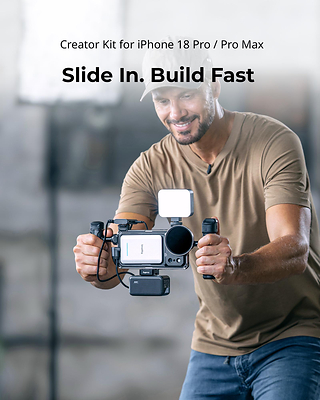
Designed around real-world shooting scenarios, the new ecosystem brings together a curated range of accessories, including MagSafe wallet stands, clip-on CPL and VND filters, 3.5x telephoto lenses, and 2-in-1 shoulder straps, enabling flexible mobile workflows for everything from casual shooting to immersive live-event coverage.

"The point," said ZHOU Yang, founder and CEO of SmallRig, "is not a single accessory but a complete workflow." Together, these products integrate stabilization, mounting, power, and creative expansion into a connected mobile production system rather than functioning as standalone accessories.
Expanding the boundaries of imaging workflows
Over the past several years, SmallRig's products have been adopted across a growing range of smartphone-based productions, from music videos and commercial projects to creator-led content. The company's mobile imaging accessories have also been selected for four consecutive years to support the production environments used in showcasing the imaging capabilities of successive new-generation iPhone devices.
As mobile production expands into increasingly professional applications, the company has continued to refine its ecosystem with solutions that improve stability, control, power management, and overall workflow efficiency across diverse shooting environments. This workflow-focused approach extends beyond product development to real-world validation. Earlier this month at IFA 2026, SmallRig showcased solutions for professional cameras, gimbal cameras, action cameras, and smartphones, placing them directly into outdoor-inspired shooting scenarios through interactive vehicle-mounted filming demonstrations.
Building on that momentum, SmallRig showcased its latest iPhone accessory ecosystem at IBC 2026 in Amsterdam, one of the world's leading events for broadcast, media, and content-production technology. To demonstrate how a complete mobile production ecosystem performs in practice, the company created motorcycle and bicycle motion-simulation shooting areas that allow visitors to experience stability, usability, and workflow efficiency in dynamic production environments firsthand. Notably, the iPhone 18 Capture Ecosystem from SmallRig was featured in The Daily, the official IBC newspaper.
Beyond mobile filmmaking, SmallRig continues to expand its expertise across a wide range of imaging applications. In addition to being featured in imaging demonstrations associated with leading smartphone brands including Huawei and vivo, the company has also developed aerospace-grade protective solutions for consumer imaging devices. Earlier this year, a customized SmallRig imaging enclosure supported onboard camera footage during the Zhuque-3 rocket mission, enabling high-resolution visual documentation under extreme operating conditions.
"Imaging innovation is no longer defined solely by the camera itself," said ZHOU. "Our mission is to unlock the full creative potential of imaging devices through scenario-driven innovation. Whether creators are capturing travel moments, producing commercial content, broadcasting live events, or operating in extreme environments, we focus on building practical workflows that help turn imaging technology into real creative productivity."
As the global creator economy continues to expand, SmallRig remains committed to developing solutions that bridge consumer devices with professional and specialized production environments, enabling creators to work confidently across an increasingly diverse range of scenarios.
About SmallRig
Founded in 2013, SmallRig is a global provider of imaging solutions, offering a comprehensive ecosystem of camera, mobile accessories, lighting, power, and audio products. Initially focused on camera mounting, SmallRig has expanded into a brand known for its versatile and compatible product ecosystem, supporting creators in over 160 countries worldwide.
For more information, visit: www.smallrig.com.
 View original content to download multimedia:https://www.prnewswire.co.uk/news-releases/smallrig-unveils-a-new-mobile-creation-ecosystem-for-iphone-18-series-302881744.html