Leopard Imaging to Showcase Advanced Embedded Vision Solutions with Future Electronics at World of Technology & Science 2026
FREMONT, Calif., Sept. 17, 2026 /PRNewswire/ -- Leopard Imaging, a global leader in AI perception and spatial intelligence solutions, will co-exhibit with Future Electronics at World of Technology & Science (WoTS) 2026, taking place September 22–25, 2026, in the Netherlands.
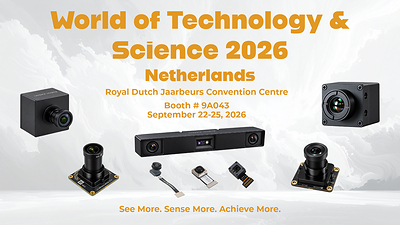
Visitors are invited to meet the Leopard Imaging and Future Electronics teams at Booth 9A043, where Leopard Imaging will showcase its latest embedded vision technologies, including stereo vision, thermal imaging, high-performance camera systems, and ultra-compact imaging solutions for robotics, autonomous systems, industrial automation, AIoT, and edge AI applications.
Featured Live Demonstrations
Eagle 1 Stereo Camera – LI-VB1940-GM2C-137H
Leopard Imaging's Eagle 1 is an RGB-IR active stereo camera designed to support advanced depth perception and day/night vision applications. The system integrates two 5.1MP BSI global shutter RGB-IR image sensors, an IR illuminator, and a dot-pattern projector.
Eagle 1 delivers both RAW RGB and IR data, enabling robust perception performance across changing lighting conditions. Its active stereo architecture makes it well suited for robotics, autonomous machines, intelligent navigation, and other applications requiring accurate spatial awareness.
DragonFire – LI-DragonFire-VGA-GM2B
The DragonFire is a high-performance uncooled infrared camera module designed for real-time thermal perception. It delivers 640 × 512 resolution at 30/60 FPS, features a 12 μm pixel size, and offers NETD performance of ≤40 mK.
Supporting a temperature measurement range from -20°C to +600°C, DragonFire is equipped with a GMSL2 interface using the ADI MAX96717 serializer, making it suitable for industrial inspection, autonomous systems, robotics, and applications requiring reliable thermal sensing.
Ultra-Compact Camera Modules
The Hummingbird family represents Leopard Imaging's series of ultra-compact MIPI camera modules designed for embedded vision and mobile applications. Delivering high-quality imaging in a miniature form factor, Hummingbird modules are ideal for wearable devices, smart cameras, mobile robotics, and next-generation embedded AI systems where size, power efficiency, and image quality are critical.
High-Performance Imaging Solutions
- LI-AR1223-YUV-MIPI-098H
A high-resolution 12MP camera featuring the AR1223 CMOS color sensor and an integrated high-performance ISP. It delivers high-quality YUV image output with strong color reproduction and adaptability across varying lighting conditions. - LI-AR0822-MIPI-126H
A 4K MIPI D-PHY camera equipped with the AR0822 CMOS image sensor. It supports advanced on-sensor eHDR reconstruction and flexible exposure ratio control, delivering clear RAW image data with enhanced dynamic range. - LI-USB30-AR0246-YUV-088H
A 2MP Hyperlux LH RGB-NIR camera featuring the AR0246 sensor, integrated ISP, and USB 3.0 interface. It provides reliable YUV output, strong image quality, and flexible performance across different lighting environments.
About Leopard Imaging
Leopard Imaging is a global leader in the design and manufacturing of AI perception and spatial intelligence solutions, providing advanced imaging technologies for autonomous systems, robotics, AIoT, automotive, industrial automation, healthcare, and edge AI applications.
For more information, visit: www.leopardimaging.com
Media Contact
Leopard Imaging Marketing Team
Ariel Zhang
 View original content to download multimedia:https://www.prnewswire.co.uk/news-releases/leopard-imaging-to-showcase-advanced-embedded-vision-solutions-with-future-electronics-at-world-of-technology--science-2026-302881394.html