KT SAT Evolves into a 'Total Space Solution Provider' Presenting the Vision of "Space for Humanity"
SEOUL, South Korea, May 22, 2026 /PRNewswire/ -- KT SAT announced that it participated in the Space Industry Forum (SIF), a global space and satellite industry event held during Asia Tech x Singapore, Asia's largest ICT exhibition, where the company shared its perspective on the rapidly evolving satellite communications market and KT SAT's future strategic direction.
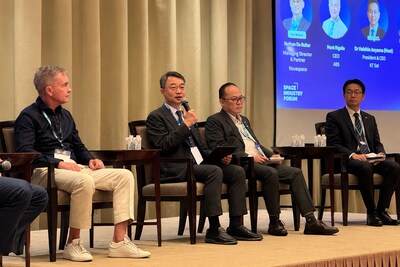
During a panel session titled "Satellite Operators at a Crossroads: Scale, Strategy, and Differentiation," Kevin Kyeong-il Choi, President & CEO of KT SAT, explained that "the satellite industry is rapidly shifting from a traditional GEO-based capacity business toward a managed service model built on multi-orbit connectivity. "He further emphasized that "in the 6G era, the integration of terrestrial and satellite networks will become essential, while the importance of sovereign connectivity for national security and communications sovereignty will continue to grow." He added, "KT SAT is evolving beyond a simple satellite capacity provider into a Total Space Solution Provider."
In particular, Choi identified three major keywords that will define the future satellite market: Sovereignty, Mobility, and Universal Connectivity. "Countries will increasingly demand independent sovereign networks," he said. "In the future, cooperation among globally interconnected sovereign networks will become increasingly important." He also noted that "in the AI era, a fully connected environment linking all people and devices will become essential, but at the same time, the digital divide could become even more severe." He added, "KT SAT is pursuing a vision of 'Space for Humanity,' providing equal connectivity opportunities for all people."
To respond to these market changes, KT SAT is strengthening its multi-orbit strategy by integrating and operating various satellite and terrestrial networks.
"Customers do not distinguish between GEO, LEO, or MEO," Choi explained. "What customers truly want is seamless connectivity." He continued, "Through XWAVE-ONE, our SD-WAN-based integrated connectivity solution, KT SAT is already operating multiple satellite and terrestrial networks together and providing services to hundreds of vessels."
Choi concluded by emphasizing that "the most important competitive advantage in the future will not simply be satellite ownership itself, but the operational capability to integrate diverse networks and services to deliver optimized connectivity for customers." He added, "Based on global partnerships, KT SAT will continue contributing to the development of a next-generation sovereign connectivity ecosystem."
Meanwhile, through its exhibition booth, KT SAT introduced several next-generation technologies and solutions, including:
- XWAVE-ONE, a multi-orbit platform integrating GEO, LEO, and LTE networks
- Operational concepts for defense aviation satellite solutions
- A next-generation PNT (Positioning, Navigation, and Timing) business direction based on TWSTFT (Two-Way Satellite Time and Frequency Transfer), capable of operating in GNSS jamming and spoofing environments
The company drew significant attention from global customers attending the event.
Photo - https://mma.prnewswire.com/media/2983915/photo.jpg
 View original content:https://www.prnewswire.co.uk/news-releases/kt-sat-evolves-into-a-total-space-solution-provider-presenting-the-vision-of-space-for-humanity-302779716.html