IBM Connects Its First Modular Cryogenic Systems in Milestone Toward Fault-Tolerant Quantum Computing
- New cryogenic quantum fridges designed to link hundreds of quantum chips.
- Cooled to below 15 millikelvin, more than 180 times colder than deep space, the build out marks a step forward in the engineering required for future quantum computers.
- Advances IBM's quantum roadmap to deliver the world's first fault-tolerant quantum computer in 2029.
YORKTOWN HEIGHTS, N.Y., Aug. 19, 2026 /PRNewswire/ -- IBM (NYSE: IBM) today announced it has successfully joined and cooled down two cryogenic modules into a single environment. The new architecture is designed to scale into the modular, shared, and ultra-cold system required to link hundreds of quantum chips into a more powerful quantum computer capable of solving large problems. Its deployment is a milestone on IBM's path to delivering IBM Quantum Starling in 2029, which is expected to be the world's first fault-tolerant quantum computer and will integrate advances across error correction, processor design, decoding, and systems engineering.
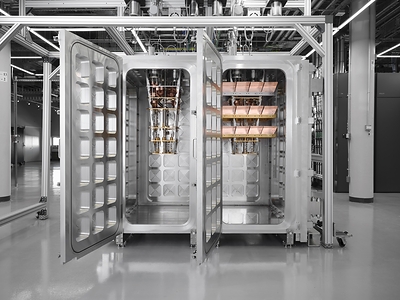
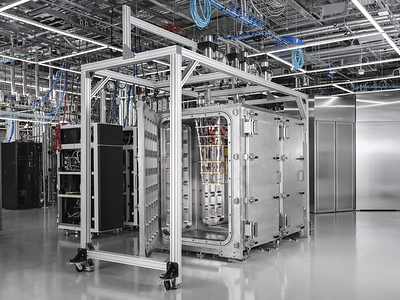
Combined, the first two operational modules stand more than 8 feet tall and 8 feet wide, and initial tests demonstrated they can jointly cool down to 4 Kelvin (the temperature of liquid helium) in under 5 days, reaching a final temperature of below 15 millikelvin shortly after. Each module's vacuum enclosure offers up to 12 times more wiring space than the most widely used IBM quantum systems, enabling more chip-to-chip connections both within and between modules.
IBM's new box-shaped design allows modules to connect in a tight row and use this larger space to directly link quantum processors with IBM's "L-coupler" technology. L-couplers connect separate quantum chips together to share information, communicate, and operate as part of a larger quantum computer.
By 2027, IBM's quantum roadmap plans to use L-couplers to link multiple processors into a larger quantum computer with at least 1,000 programmable qubits, which are qubits that can be directly used to perform computations. Towards this goal, IBM will install IBM Quantum Nighthawk processors into the cryogenic modules later this year to expand operational performance testing. At the time Starling is delivered, IBM plans for each cryogenic module to house thousands of qubits.
IBM's plans for Starling were introduced last year with a new error correction code that dramatically reduces the physical resources required for fault tolerance. Since then, the company's progression has remained on course, including the demonstration of core hardware components and breakthroughs in efficient error-correction decoding.
"Bringing fault-tolerant quantum computers to industries depends on several fundamental advances," said Jay Gambetta, Director of IBM Research and IBM Fellow. "The successful connection and operation of these cryogenic modules signals a leap forward in that direction and will accelerate our progress alongside continued innovation in quantum hardware, software, and algorithms."
IBM expects its scalable cryogenic modules to help speed its pace of innovation. For example, three essential components of IBM Quantum System Two's environment are built into the new architecture, but now in a way that allows each part to be independently tested, improved, and rapidly iterated.
The delivery of these new cryogenic quantum modules is further evidence that IBM is systematically delivering against its quantum roadmap, solving another one of the major hurdles required to accelerate its path to fault-tolerant quantum computing.
About IBM
IBM is a leading provider of global hybrid cloud and AI, and consulting expertise. We help clients in more than 175 countries capitalize on insights from their data, streamline business processes, reduce costs and gain the competitive edge in their industries. Thousands of governments and corporate entities in critical infrastructure areas such as financial services, telecommunications and healthcare rely on IBM's hybrid cloud platform and Red Hat OpenShift to affect their digital transformations quickly, efficiently and securely. IBM's breakthrough innovations in AI, quantum computing, industry-specific cloud solutions and consulting deliver open and flexible options to our clients. All of this is backed by IBM's long-standing commitment to trust, transparency, responsibility, inclusivity and service. Visit www.ibm.com for more information.
Media contacts:
Dave Mosher
IBM
dave.mosher@ibm.com
Erin Angelini
IBM
edlehr@us.ibm.com

 View original content to download multimedia:https://www.prnewswire.co.uk/news-releases/ibm-connects-its-first-modular-cryogenic-systems-in-milestone-toward-fault-tolerant-quantum-computing-302854646.html