Creality Unveils K3, SPARKX i8 and Expanded Creative Ecosystem at IFA 2026
BERLIN, Sept. 6, 2026 /PRNewswire/ -- Creality, a global leader in 3D printing, unveiled its latest product portfolio at IFA 2026, bringing together new developments across multi-channel and multi-material 3D printing, filament recycling, resin printing, 3D scanning, laser creation, and digitally manufactured consumer products.
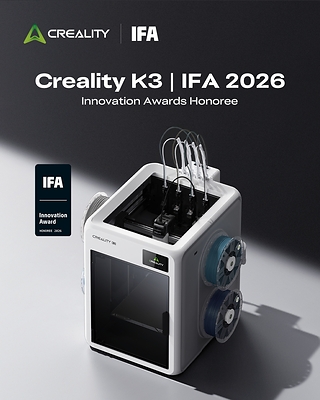
The new lineup arrives with recognition from the IFA Innovation Awards 2026, with the Creality M1 Filament Maker named a Winner and the new flagship K3 recognised as an Honoree. The honours highlight Creality's continued innovation across both next-generation 3D printing and more sustainable material workflows.
Leading Creality's 3D printing lineup are the new K3 and SPARKX i8, representing two approaches to more efficient and versatile multicolour printing. They are joined by the large-format Ender-3 V3 Mega, the new HALOT-X1 Max and HALOT-X1 Neo resin printers, the portable Pika 3D scanner, Creality's latest A1C and T1C laser systems, and Nexbie 3D-printed footwear.
K3: Award-Recognised Multi-Channel and Multi-Material Innovation
Recognised as an IFA Innovation Awards 2026 Honoree, the K3 represents the latest evolution of Creality's flagship K Series. Powered by the built-in KliTek™ multi-channel system, it enables nozzle swaps in just 4.8 seconds, eliminating the repeated filament retraction, reloading, and heavy purging typical of single-nozzle multicolour printers. The system cuts total print time by up to 80%* and material waste by up to 85%*.
With optional add-on accessories, the K3 unlocks advanced multi-material capabilities and mixed-nozzle printing. It handles soft, flexible filaments including TPU 85A–95A, combines materials of varying hardness in a single build, and supports hybrid nozzle configurations—pairing a 0.4 mm nozzle for high-precision outer walls with a 0.8 mm nozzle for rapid infill, boosting print efficiency by up to 30%*. Combined with an AI-assisted workflow and an open ecosystem, the K3 expands creative possibilities for makers, print farm operators, and industrial professionals alike.
*Data based on Creality's internal testing. Actual results may vary depending on testing conditions.
M1: Award-Winning Filament Recycling
Named a Winner at the IFA Innovation Awards 2026, the M1 Filament Maker extends 3D printing into a more circular material workflow. Working with the R1 Shredder, the system enables users to process plastic and failed prints into new filament, while also supporting customised material formulations for greater experimentation and reuse.
SPARKX i8: Efficient Four-Colour Creation
The SPARKX i8 makes four-colour printing faster, cleaner, and easier to use. Its four-channel toolhead and 4-in-1 hotend keep four filaments ready at once, while a short shared melt zone minimises purging between colours, reducing material waste and transition time.
Combined with AI-assisted creation and intelligent printing features, the i8 is designed to shorten the journey from an initial idea to a finished multicolour object with fewer manual steps.
Expanding the AI-Powered Creative Ecosystem
Creality has also expanded its FDM lineup with the Ender-3 V3 Mega, combining a 420 × 420 × 420 mm build volume with support for 85A–95A TPU. Designed for large models and batch production, it brings greater scale and material flexibility to the Ender platform.
The resin lineup has grown with HALOT-X1 Max and HALOT-X1 Neo. The X1 Neo offers a compact, accessible entry point with high-resolution printing and AI-assisted creation, while the flagship X1 Max combines a 17.1 L build volume, 16K display, 40°C active heating, quad-lead-screw architecture, and a 5 L smart resin system for larger, continuous production.
For 3D scanning, the new Pika packs a seven-line blue laser and NIR scanning into a portable 260 g body, delivering accuracy up to 0.03 mm and scanning speeds of up to 110 fps. AI-powered processing and wireless connectivity further simplify the path from physical objects to editable digital models.
Creality's latest laser solutions further extend the ecosystem into engraving, cutting, marking, and personalisation, giving creators more ways to turn digital designs into physical objects.
Beyond creative tools, Creality is showcasing the possibilities of digital manufacturing through Nexbie and its latest 3D-printed footwear collection. Models including CloudWing, CloudSpark, and CloudX combine DLP printing, advanced elastomers, and digitally engineered structures to explore new approaches to footwear design and production.
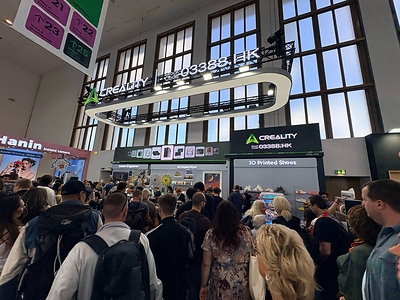
As IFA continues, Creality's booth H20.143 remains open to visitors looking to explore its latest products and hands-on experiences. From the award-recognised K3 and M1 to new developments across multicolour printing, scanning, laser processing and digitally manufactured consumer products, the portfolio reflects Creality's broader ambition to make advanced digital fabrication more accessible across the creative workflow.
 View original content to download multimedia:https://www.prnewswire.co.uk/news-releases/creality-unveils-k3-sparkx-i8-and-expanded-creative-ecosystem-at-ifa-2026-302870785.html