ASUS Advances AI Factories with Integrated Infrastructure and Operational Governance
Uniting accelerated computing, simulation-validated deployment and AI governance into one continuous AI factory platform
SEOUL, South Korea, Sept. 3, 2026 /PRNewswire/ -- At ASUS AI Tech 2026, ASUS today redefined AI infrastructure from systems that run AI to platforms that build and operate AI factories. Working with NVIDIA and a growing ecosystem of technology partners — including Aleria, AMD, Crusoe, Foxlink, IBM, Intel, Samsung, Schneider Electric and WD — ASUS is enabling enterprises to move beyond standalone infrastructure to production-ready AI factories where performance, operational resilience and AI governance are engineered across the entire lifecycle.
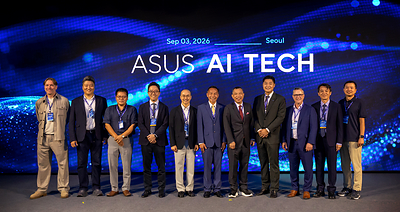
ASUS also reinforced its unified AI infrastructure platform spanning accelerated computing, networking, storage, deployment software, AI operations and governance. By integrating infrastructure engineering, deployment and operational intelligence into a continuous platform, ASUS helps organizations shorten time to first token, accelerate time to revenue and optimize infrastructure efficiency while maintaining trusted AI at scale. This strategic evolution solidifies the role of ASUS as a pivotal end-to-end AI infrastructure partner, transforming computing capacity into tangible, business-driving AI innovation.
"ASUS is now comprehensively embracing its All in on AI strategic initiative, dedicated to embedding AI across infrastructure, commercial solutions, and innovative physical devices. As AI factories evolve into always-on production environments, infrastructure performance and AI governance can no longer be addressed separately. Infrastructure is the foundation of AI production itself. From the decisions that shape the first token to the controls that govern AI at scale, ASUS is engineering for what comes next—bringing compute, connectivity, power, cooling and automation together to turn every watt, every dollar and every minute invested into AI output." said Paul Ju, Senior Vice President, Head of Infrastructure Solution Business Group, ASUS.
AI governance starts before the first token
Building a trusted AI factory begins long before the first model is deployed. ASUS combines advanced system engineering with the NVIDIA DSX Sim Blueprint to help enterprises design, simulate, validate and optimize complete AI factories before physical deployment. Working with ecosystem partners including Schneider Electric, AVEVA and IBM, ASUS brings compute, networking, storage, power, cooling and facility infrastructure into a unified digital twin environment, enabling organizations to identify constraints, optimize configurations and reduce deployment risk before installation begins.
Once deployed, governance extends throughout AI operations. As agentic AI and physical AI become increasingly autonomous, organizations require continuous visibility, oversight, and operational control across models, data, tools and enterprise systems. Beyond the infrastructure management platforms, ACC (ASUS Control Center) and AIDC (ASUS Infrastructure Deployment Center), ASUS significantly extends these capabilities through its comprehensive AI Software Stack and Turnkey AI Applications. Within the AI Software Stack, customers gain direct access to essential tools such as Quota & Billing and an MLOps Portal. These facilitate efficient resource management within the data center, thereby accelerating overall operational speed. At the application level, the AI Software Stack acts as a crucial operational layer and cross-platform software stack. It functions as an 'operational harness', connecting enterprise governance directly with AI services and autonomous agents, enabling secure, manageable, and production-ready deployment of agentic AI.
Backed by advanced integration capabilities and a long-standing collaboration with NVIDIA, ASUS enables enterprises to accelerate AI from design to deployment and ongoing operations. Strong business growth reflects increasing market demand for integrated AI infrastructure that shortens time to first token, accelerates time to revenue and supports AI factories ranging from frontier-scale model development to enterprise, agentic and edge AI deployments.
- For large-scale AI factories: ASUS AI POD, XA VR721-E3, built on NVIDIA Vera Rubin NVL72, provides a rack-scale platform for high-volume intelligence and low cost token generation delivering 10X the performance per watt versus the prior generation. Complementing this, the enterprise-ready XA NR1I-E12LR and XA NR1I-E12L, based on NVIDIA HGX Rubin NVL8, accelerate high-density AI infrastructure for demanding enterprise training, inference, and post-training workloads.
- For agentic AI: The ASUS XA P2N-E2, a 2U NVIDIA MGX platform equipped with two NVIDIA Vera CPUs and supporting up to two dual-slot NVIDIA GPUs, is purpose-built for responsive, energy-efficient agentic reasoning, data processing, and orchestration at scale.
- For edge and visual computing: ASUS ESC8000-E12P, featuring NVIDIA RTX PRO 6000 and RTX PRO 4500 Blackwell Server Edition GPUs, extends acceleration for enterprise inference, vision AI, and visual computing from the data center to the edge. Additionally, the compact PE3000N edge-AI platform, powered by NVIDIA Jetson Thor T5000 module, delivers real-time inference, sensor fusion, and autonomous control for robotics and industrial automation environments.
- For robust data foundation: The ASUS UF920-E3-RS24 server, based on the NVIDIA STX modular foundation for AI-native storage, together with the ASUS OJ340A-RS60 object storage solution and VS320D-RS26N storage system, provides the resilient data foundation required for enterprise AI. Designed to meet the capacity, availability and data management demands of modern AI pipelines, the portfolio supports AI factories from design validation to production-scale deployment.
Customer applications and AI factory implementation
Beyond foundational infrastructure, ASUS showcased AI's tangible impact through key partner demonstrations, illustrating real-world applications and emerging AI paradigms. Foxlink demonstrated next-level industrial automation with autonomous robotics, while Aleria highlighted the critical need for Sovereign AI deployments designed to support localized data control and secure operations. This holistic approach, combined with robust ASUS software-hardware integration and Kubernetes platforms, significantly shortens time-to-revenue for our customers. The ASUS vision extends beyond merely selling computing power; we deliver operational AI factories designed to continuously generate business value and drive the token economy.
Accelerating AI adoption for transformative growth
Looking ahead, ASUS is committed to continuously deepening its collaboration with NVIDIA and a growing global ecosystem of technology partners. By integrating accelerated computing, simulation-validated deployment, and AI harness engineering into one continuous governance framework, we empower organizations to protect their infrastructure investments and maintain control as AI applications grow in complexity and autonomy. Our overarching goal is to help enterprises transition from simply investing in AI to embedding intelligence across their entire operations. This strategic shift is designed to shorten time to revenue, improve efficiency of tokens per watt, significantly reduce resource waste and TCO, and ultimately build AI Factories engineered for peak performance, designed for adaptability, and governed for scalable growth.
AVAILABILITY & PRICING
ASUS servers are available worldwide. However, the availability of certain other ASUS products is subject to local regulatory requirements. For specific product availability and offerings in your region, please contact your local ASUS representative.
 View original content to download multimedia:https://www.prnewswire.co.uk/news-releases/asus-advances-ai-factories-with-integrated-infrastructure-and-operational-governance-302869213.html